Planning a trip to Tulum and wondering how hurricane season fits into your dates? You are in the right place. At Casa Nalum, our eco villa sits inside the UNESCO Sian Ka’an Biosphere Reserve, right between the Mayan lagoon of Campechen and the Caribbean Sea. We have welcomed guests through every month of the year, from bright dry-season mornings to the moody rolling clouds of September.
The short version: hurricane season in Tulum runs from June 1 to November 30, and direct hurricane hits are historically rare. Most days are still sunny, and travelers who plan smart often score better prices, quieter beaches, and lush green jungle. In this local guide we will walk you through the real risk month by month, what a storm actually looks like on the ground, and safety infrastructure you should know about
When Is Hurricane Season in Tulum?
Tulum sits on Mexico’s Caribbean coast in the state of Quintana Roo, and it follows the Atlantic hurricane calendar. The official window is June 1 through November 30, with peak activity in September and October.
Here is the important nuance most travel articles skip: the local rainy season and the hurricane season overlap, but they are not the same thing. Rain begins to pick up in late May and eases by mid November. Serious tropical systems are concentrated in a much narrower window inside that stretch, mostly late August to mid October.
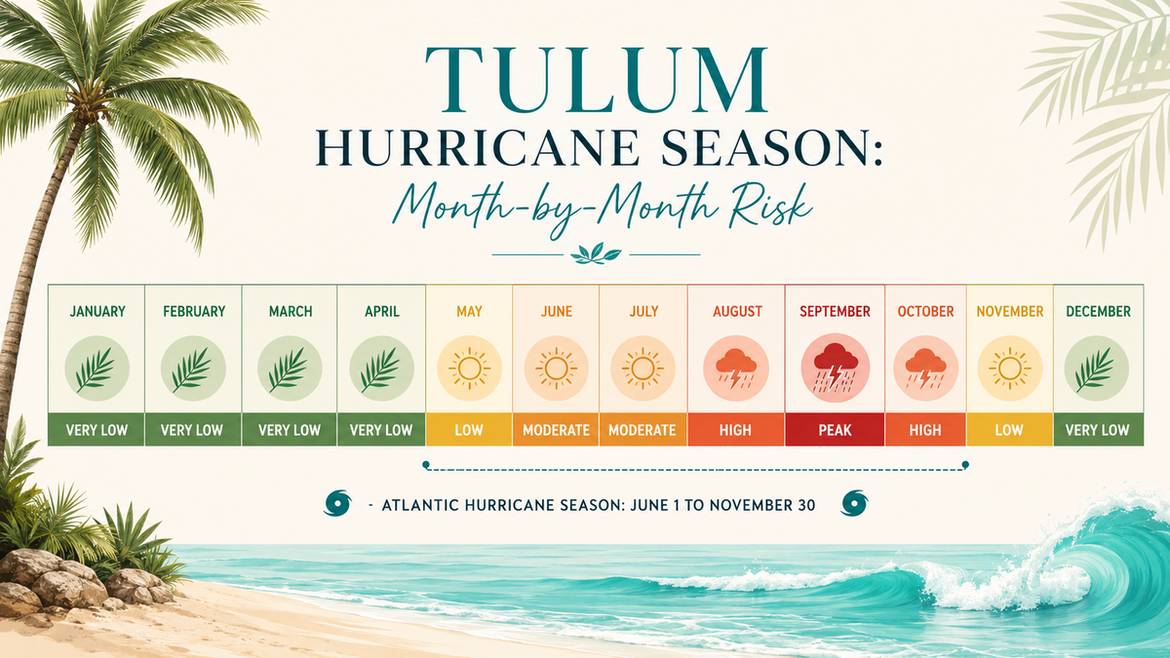
Month by Month Risk (Historical View)
Using historical tropical cyclone probability data for the Tulum area, here is roughly what each month looks like:
- January to April: Around 0 to 1 percent chance of a tropical system. Dry season, lowest humidity, minimal rainfall. This is our busiest guest season for a reason.
- May: Very low risk. Rain begins in short afternoon bursts. One of our favorite shoulder months.
- June: 3 to 5 percent risk. Start of the Atlantic season, humidity climbs, mornings still glorious.
- July: 5 to 8 percent risk. Warmer, more humid, brief showers common.
- August: 8 to 10 percent risk. Core rainy season, tropical disturbances more frequent.
- September: 15 to 20 percent risk. Statistically the peak month for hurricane and tropical storm activity in Tulum, and the rainiest month with an average of 159 mm of rainfall.
- October: 12 to 15 percent risk. Still peak season, but temperatures begin easing.
- November: 3 to 5 percent risk. The tail. By mid month, the dry season is essentially back.
- December: Around 0 to 1 percent. Dry, breezy, and beautiful.
If your goal is to minimize hurricane risk specifically, aim for December through April, with May and late November as excellent shoulder options.
What a Hurricane Actually Looks Like in Tulum
The word “hurricane” understandably sparks anxiety, so let’s ground it in what these systems really mean for the region.
Since 1951, at least 11 Category 3 to 5 hurricanes have struck the coast of Quintana Roo. Direct major hurricane impacts on the Tulum area happen roughly once per decade. Far more common are outer rainbands from passing storms, which typically bring one to three days of heavy rain, 40 to 60 mph winds, temporary flooding, and beach erosion, but usually without widespread structural damage.
Recent named storms in the Tulum area:
- Hurricane Wilma (2005) was a Category 4 to 5 event that reshaped much of the Riviera Maya. It remains the reference point for major storms in the region.
- Hurricane Dean (2007) made landfall on the Yucatán Peninsula, bringing strong winds and heavy rain to Tulum.
- The 2020 trio (Gamma, Delta, Zeta) hit the region in quick succession. Delta, a Category 4 at landfall near Puerto Morelos, had a lesser direct effect on Tulum, but cumulative flooding stressed drainage and services.
- Hurricane Grace (2021) made landfall just south of the Tulum archaeological zone on August 19, 2021, with 80 mph sustained winds. It knocked out power to about 65,000 customers in Playa del Carmen, Cozumel, Puerto Aventuras, and Tulum, but no deaths were reported.
- Hurricane Beryl (2024) brought hurricane-force winds and widespread outages to parts of Quintana Roo.
- The 2025 season produced 13 named storms and 4 major hurricanes, but none made landfall on the coast of Quintana Roo.
What tends to happen on the ground:
Strong winds can topple trees and power poles. Authorities sometimes cut power pre-emptively before landfall to protect the grid. Internet can go down for extended periods because the central plant historically lacked backup power. Beaches and dunes erode, and the coastal hotel zone along Tulum’s beach road is directly exposed to storm surge. Modern buildings are largely reinforced concrete, which has kept casualties very low even in serious events.
Safety Infrastructure You Should Know About
Tulum and the wider Quintana Roo state operate under Mexico’s civil protection system. Here is what that looks like in practice:
- Alerts and evacuations are issued by state and municipal authorities. Guests should monitor these and follow instructions from their host or hotel.
- Official shelters are designated public buildings (schools, gyms, community centers) built to withstand high winds. They are activated when higher-level hurricane alerts are issued.
- Reef protection matters more than most visitors realize. Analyses after Wilma, Emily, and Dean found that hotel zones protected by intact reef, like Puerto Morelos, took far less physical damage than reef-degraded areas.
- Parametric reef insurance: Quintana Roo and The Nature Conservancy created a Coastal Zone Management Trust that pays out when a hurricane of specified intensity passes the Mesoamerican Barrier Reef. Payouts fund rapid reef and beach restoration.
- Hotels and villas are expected to have emergency plans aligned with civil protection protocols. At Casa Nalum, we brief every guest at check-in during storm-risk months.
Why We Still Love the Shoulder Weeks
Now for the honest, local perspective: hurricane season is not a season to avoid. It is a season to travel smart.
What you gain by visiting between June and early November:
- Lower rates. September and early October are the cheapest weeks of the year, sometimes 30 to 50 percent below peak.
- Fewer people. Beaches feel private. Cenotes are quiet. Restaurants take reservations same-day.
- Lush, green Sian Ka’an. The jungle is at its most alive.
- Less seaweed in many summers. Sargassum patterns are unpredictable, but July and August have often been kinder than late spring for us.
- Dramatic light. Storm cells at sunset over the lagoon are unforgettable.
What you should plan for:
- Buy travel insurance that explicitly covers hurricanes and weather cancellations. This is non-negotiable in September and October.
- Pack a light rain jacket, quick-dry clothes, and waterproof shoes for cenote paths.
- Build flexibility into your itinerary. Have a rainy-day plan B for every outdoor day.
- Book with a host that has a clear storm protocol. Ask before you book if you are traveling in September or October.
Local Tips for a Hurricane-Season Trip
After years of hosting guests through Junes, Septembers, and Novembers, here is what we tell everyone before they book:
- Watch the National Hurricane Center, not just your phone’s weather app. Tropical systems are usually visible five to seven days out. That is enough time to adjust plans.
- Book flexible flights and refundable villas whenever possible in September and October.
- Travel insurance is essential. Look for a policy that covers “hurricane warning at destination” as a trip-cancellation trigger, not only physical damage.
- Charge everything. Pre-storm outages can last from hours to days. Battery banks, headlamps, and a Kindle full of downloads make the difference.
- Cash on hand. ATMs and card readers depend on the same grid as your air conditioning.
- Trust your host. At Casa Nalum we track systems from the moment they form and communicate proactively. If we tell you to relocate or wait it out with us, there is a reason.
- Do not panic-cancel a Category 1 forecast. Most storms weaken over the Yucatán, and the vast majority of our September and October guests never see anything worse than a memorable thunderstorm.
Plan Your Tulum Escape
Hurricane season Tulum is not a red flag on the calendar. It is a nuance to understand. With a little planning and the right home base, the June to November stretch can deliver some of the most beautiful, quiet, and affordable weeks of the year on this coast. The jungle is greener, the sunsets are more dramatic, and the beaches feel like your own.
Casa Nalum was built for exactly this kind of thoughtful travel. Between the lagoon and the sea, inside a protected biosphere, with a team who knows every tide and every storm signal on the horizon. When you are ready to see the Yucatán the way we see it, book your dates or contact us and we will help you time it right.
Frequently Asked Questions
Is Tulum safe to visit during hurricane season?
Yes, with sensible planning. Direct major hurricanes are rare, most trips see no more than passing showers, and Quintana Roo has a well-organized civil protection system with designated shelters and reinforced buildings. The main precautions are travel insurance that covers hurricane cancellations, flexibility in your itinerary, and staying with a host or hotel that has a clear storm protocol.
What are the worst months to visit Tulum for weather?
September is statistically the highest-risk month for hurricanes and tropical storms, and also the rainiest. October comes in a close second. If avoiding storm risk is the top priority, these are the two months to skip. If you are hunting for the best prices and fewest crowds, they are also the months with the deepest discounts.
Are there hurricanes in Tulum in July?
Tropical systems in July exist but are less common than August through October. Historically, July carries about a 5 to 8 percent chance of a tropical system affecting the Tulum area, with more frequent short showers and warm humid days. Direct hurricane hits in July are unusual.
What should I pack for Tulum during hurricane season?
A light rain jacket, quick-dry clothes, waterproof sandals or water shoes for cenotes, a portable battery bank, biodegradable sunscreen and bug spray, a small dry bag for phones and cameras, and a headlamp or small flashlight in case of power outages. Pack medication and important documents in your carry-on.
Does travel insurance cover hurricanes in Tulum?
Standard travel insurance often covers hurricanes only after a specific “hurricane warning” is issued for your destination, and only if you booked before the storm was named. For September and October travel, look for “cancel for any reason” coverage or policies that name hurricane events as covered cancellations. Read the fine print carefully.
What happens if a hurricane hits during my Tulum vacation?
Your host or hotel will follow local civil protection guidance. Expect pre-emptive power cuts, potential internet outages, and possible beach closures. If a serious storm is forecast, authorities may recommend relocating from beachfront to inland shelters. Modern buildings in the region are reinforced concrete and have kept casualties near zero in recent storms. Stay calm, follow instructions, and keep chargers, cash, and water ready.